University research on hearing loss in veterans published by Royal British Legion
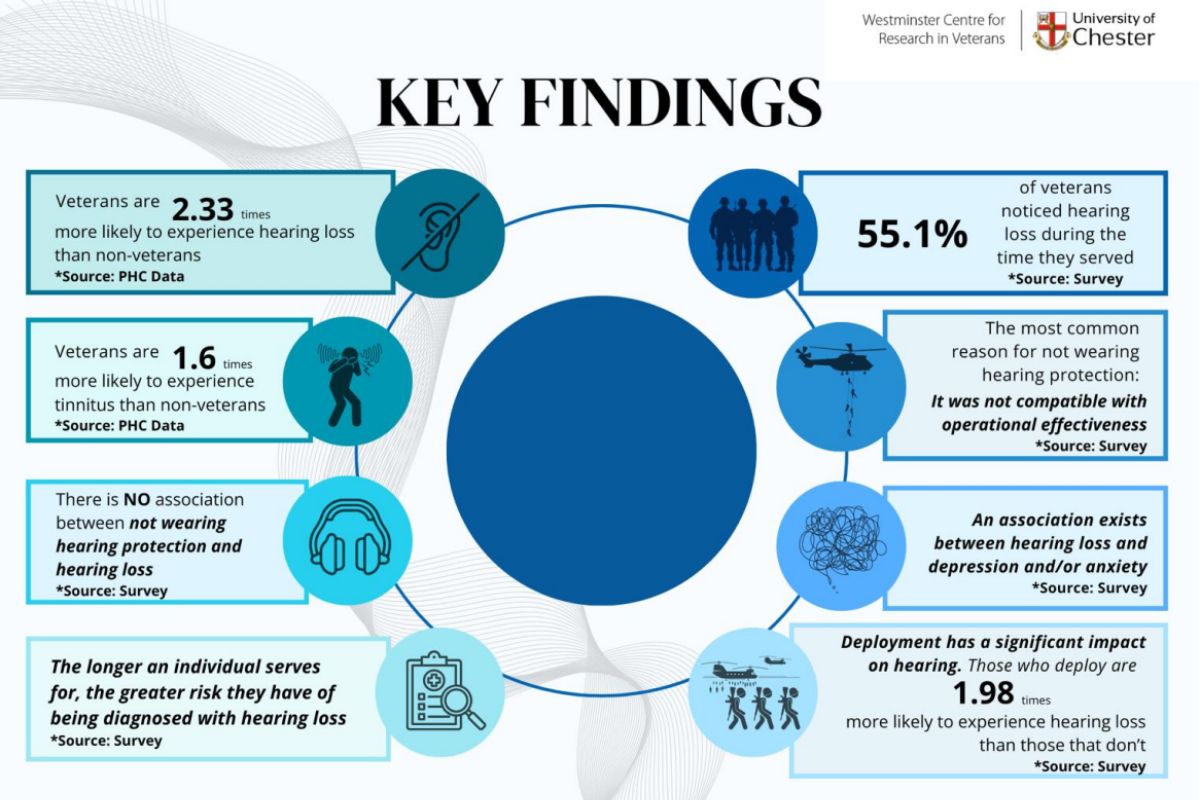
New University research has revealed UK Armed Forces veterans are 2.33 times more likely to experience hearing loss than non-veterans, and 1.6 times more likely to experience tinnitus.

The findings, published in a new report by the Royal British Legion (RBL), follow the first large-scale independent research study into hearing loss with working-age UK Armed Forces veterans, and has been carried out by the University of Chester’s Westminster Centre for Research in Veterans. The centre was awarded funding in 2023 to carry out the research with the aim of understanding the impact of hearing loss resulting from military Service, as well as evaluating whether current support provision meets veterans’ needs, and informing recommendations for policy and practice.
A total of 658 veterans were surveyed about their experiences, with several later interviewed about the level of noise they experienced and their use of hearing protection. The results of the survey showed there was no association between not wearing hearing protection and hearing loss, with the most common reason for not wearing hearing protection being it was not compatible with operational effectiveness. The survey showed an association between hearing loss and experiencing symptoms of anxiety and/or depression.
Among its conclusions, the RBL report recommends a series of measures to strengthen support and guidance for the Armed Forces community affected by service-attributable hearing impairment and/or tinnitus, including making compensation and hearing aids more accessible.
Professor Basma Ellahi, Associate Dean Research and Innovation at the University’s Faculty of Health, Medicine and Society, said: “This strategic and innovative research has focused on a fundamental issue of relevance to our veteran community. The findings should inform future directions for practice and policy to better support veterans and their support networks.
“We are grateful not only to the veterans who participated, but also recognise the wider academic community and other stakeholders who were instrumental in shaping the research direction and ensuring evidence-based recommendations."
Angela Kitching, Director of Campaigns, Policy, and Research (jobshare) at the Royal British Legion, said: “The Royal British Legion has long recognised the challenges Service-related hearing impairment presents for veterans and their families.
“We welcome this research, which fills an important evidence gap on hearing loss and tinnitus in working-age veterans. This evidence will help inform policy and practice, ensuring support better reflects the needs of those affected.”
Army veteran Dan Darkes, 37, from Northampton, was just 23 when he was medically discharged from the Army for hearing loss. He was on tour in Afghanistan with the Grenadier Guards when a rocket-propelled grenade blast ruptured his ear drum. He completely lost his hearing for three weeks and was discharged within a year and was returned to civilian life and struggled to adapt.
He eventually reached out to the Royal British Legion, who provided support for his mental health and helped him to get hearing aids and fought for him to get better compensation through their War Pensions Service.
Dan said: “I had no one to go to. I hear a loud thumping noise in my left ear and at night when it’s quiet, the ringing gets louder. It can be hard to sleep. It gets you down and I did struggle with my mental health.”
The RBL report can be viewed at: https://www.britishlegion.org.uk/about-us/our-campaigns/policy-and-research/hearing-impairment-impact-on-working-age-uk-veterans.