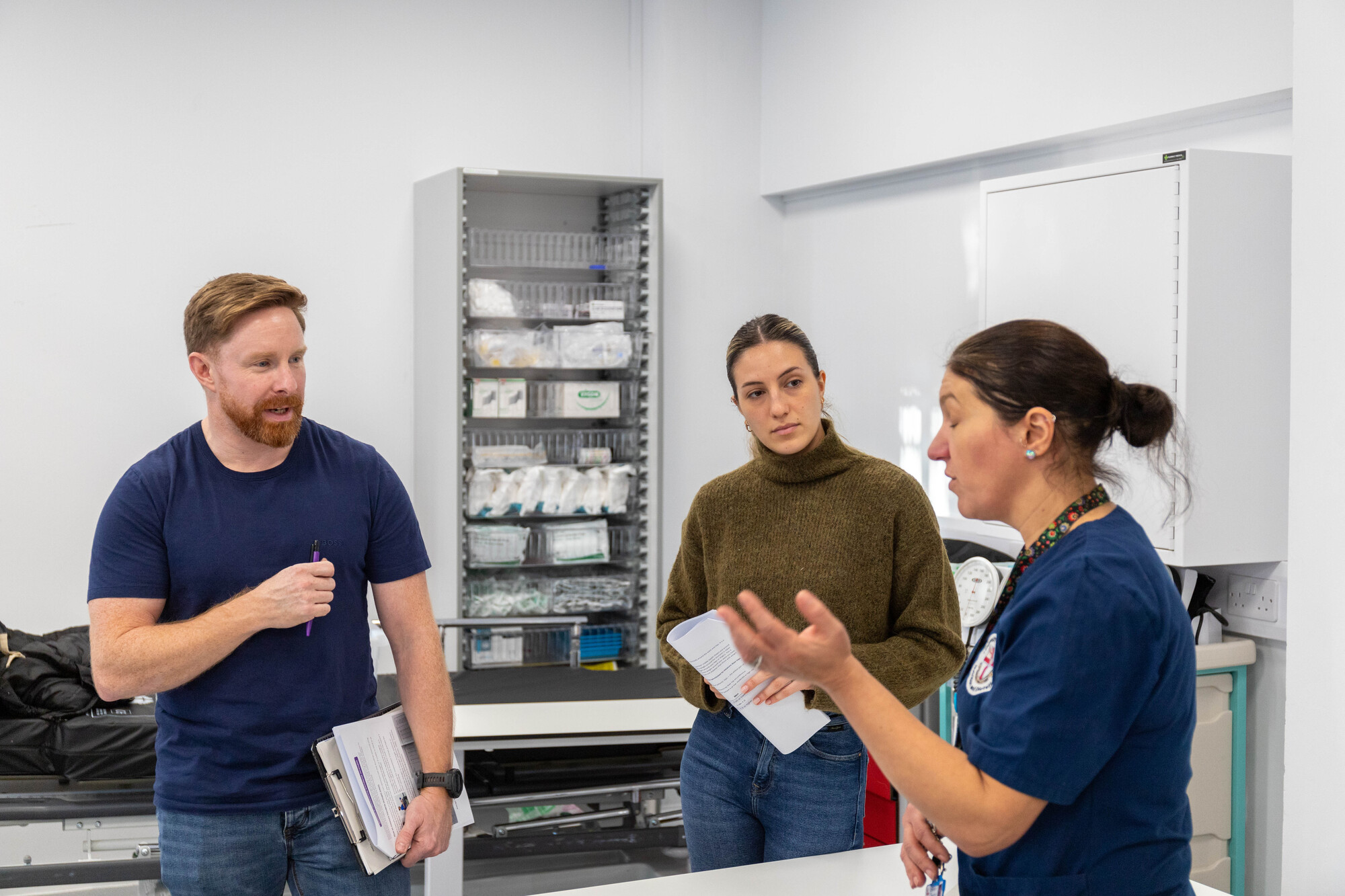
Dietetic students in a clinical setting

The MSc in Lifestyle Medicine (Obesity) covers a range of interdisciplinary topics focused on preventing, managing, and reversing chronic diseases through evidence-based lifestyle interventions.

Whilst it does have a particular emphasis on obesity, it covers other non-communicable diseases such as cardiovascular disease, type 2 diabetes, cancer, osteoporosis and mental health disorders.

Core topics include Nutrition and Metabolic Health, Physical Activity and Exercise Prescription, Mental Health, Well-being and behaviour change, Research Methods and Evidence-Based Practice and Clinical and Practical Applications.

This course equips graduates with the skills to integrate lifestyle interventions into clinical practice, public health, and wellness coaching, improving health outcomes on both individual and societal levels.

A Master's degree in Lifestyle Medicine (Obesity) opens up diverse career opportunities in healthcare, public health, research, and wellness. Graduates can work in clinical, corporate, academic, and community settings to promote disease prevention and holistic health.


What You'll Study

The course consists of six core modules of 20 credits, delivered across three terms and a 60-credit dissertation/research project.

Modules

This engaging module delves into the global obesity epidemic, equipping students with a comprehensive understanding of the causes, consequences, and challenges of obesity and weight management. You will explore national and international obesity trends in both children and adults, analysing the dietary, physical activity, economic, and social factors driving this public health crisis. The module also examines the serious health implications of obesity at both individual and population levels, highlighting its impact on chronic diseases and healthcare systems. A key focus is on developing critical evaluation skills, enabling students to assess prevention and intervention strategies aimed at tackling obesity. By the end of this module, you will be able to interpret obesity-related research, contribute to evidence-based discussions, and apply knowledge to real-world public health initiatives, preparing you for careers in nutrition, healthcare, and policy development.

This module dives into the critical connections between nutrition and health, exploring how diet shapes the risk and prevention of chronic diseases like cardiovascular disease, cancer, and diabetes. You’ll investigate nutritional epidemiology and public health, examining how food choices and eating behaviours differ across populations. The role of scientific advisory committees and regulatory agencies will be unpacked, revealing how policies influence what we eat. Most importantly, this module equips you with the skills to analyse and apply evidence-based dietary strategies to improve health outcomes. By understanding healthy eating recommendations and the science behind them, you’ll be prepared to navigate emerging nutrition challenges and contribute to public health initiatives. Whether you aim to work in healthcare, policy making, or nutrition research, this module provides essential expertise for making a real-world impact on diet-related health issues.

Module Content:

  1. Emerging concerns in nutrition and health
  2. Dietary factors in the aetiology and prevention of chronic diseases (eg. cardiovascular disease, cancer, diabetes).
  3. Nutritional epidemiology and public health.
  4. Nutrition needs of different groups, including eating behaviour and food choice.
  5. Role of scientific advisory committees and regulatory agencies.
  6. Healthy eating recommendations for the general public.

This module equips you with essential skills in nutritional and anthropometric assessment, teaching you how to evaluate a client’s dietary needs using research-backed methods and best-practice guidelines. You’ll master dietary assessment techniques, from gathering and interpreting dietary information to analysing the complex relationship between diet, health, and disease. Hands-on experience with dietary analysis software and biochemical assessments will sharpen your ability to assess nutritional status with precision. Additionally, you’ll explore nutritional anthropometry, learning how to measure weight, height, BMI, muscle mass, and body fat, while understanding their uses and limitations. Key screening tools like the Malnutrition Universal Screening Tool (MUST) will prepare you to identify and address nutritional risks effectively. This module is vital for those pursuing careers in nutrition, healthcare, and public health, ensuring you develop the analytical and practical skills needed to assess and improve nutritional health in diverse populations.

Module content:

  1. Dietary Assessment
    • Obtaining and interpreting dietary information to assess nutritional/health status
    • Obtaining and interpreting information about the interaction of diet, health and disease
    • Use of dietary analysis software
    • Biochemical assessment of nutritional status
  2. Nutritional anthropometry. Uses and limitations of:
    • Weight
    • Height and Proxy measures for height etc.
    • Indices e.g. Body Mass Index (BMI)
    • Circumferences e.g. mid-upper arm circumference (MUAC)
    • Estimation of muscle
    • Skinfolds and the assessment of body fat
    • Screening tools using anthropometry e.g. Malnutrition Universal Screening Tool (MUST)

This module provides a comprehensive understanding of clinical exercise testing and prescription, equipping you with the skills to assess and design exercise programs for health and disease prevention. You’ll explore the role of exercise in cardiovascular health, learning essential pre-exercise screening and risk stratification methods. Through both lab-based and field-based assessments, including cardio-pulmonary and submaximal fitness tests, you’ll gain hands-on experience in evaluating functional capacity. A key focus is on analysing exercise and respiratory responses to inform safe and effective exercise prescriptions, factoring in heart rate, perceived exertion (RPE), and cardiovascular medications. Practical skills in aerobic fitness testing, such as Step, Cycle, and Shuttle Walk Tests, will prepare you for real-world clinical settings. By the end of the module, you’ll have the expertise to develop tailored exercise programs, ensuring safety and maximising health benefits for individuals across various fitness and medical conditions.

This module provides a comprehensive foundation in research methods and data analysis, equipping you with the skills to design, conduct, and interpret scientific research. You’ll explore different research types—analytical, descriptive, experimental, and qualitative—while mastering key concepts like hypotheses, variables, sampling, and measurement reliability. Learn how to collect and analyse data effectively, from experimental designs and surveys to case studies and qualitative research techniques. A strong emphasis on ethical research practices ensures you understand the responsibilities of scientific inquiry. You’ll also gain hands-on experience with SPSS software, learning to establish databases, transform variables, and apply statistical tests like ANOVA, t-tests, and chi-square analyses. By the end of the module, you’ll be able to critically evaluate research, apply statistical techniques, and use data-driven insights to inform decision-making—essential skills for careers in academia, healthcare, and scientific research.

This module provides an opportunity to conduct independent research, allowing you to contribute to the growing body of knowledge in your field of study. Working closely with a supervisor and research coordinator, you will design and execute a research project that aligns with your academic discipline. This involves identifying a research question, reviewing existing literature, selecting appropriate methodologies, and analysing data to generate meaningful insights. Through this process, you’ll develop critical thinking, problem-solving, and research skills, essential for academic and professional success. The module emphasises independent inquiry and evidence-based analysis, preparing you to engage with real-world challenges in your chosen field. By the end, you’ll have completed a rigorous, well-structured research project, demonstrating your ability to contribute valuable findings to your discipline—an essential competency for further study, professional research, or industry application.

This module delves into the sociological and psychological influences on nutrition and health behaviours, equipping you with essential skills for public health nutrition and dietetics. You’ll explore key psychological theories, including social cognition models, motivation, and personality factors, to understand how people make food choices. A strong focus is placed on behaviour change strategies, such as motivational interviewing, cognitive-behavioural techniques, and health promotion methods, which are critical for improving dietary habits and public health outcomes. The sociology of food and eating is also examined, covering cultural, religious, and socio-economic factors that shape nutrition patterns. Additionally, you’ll gain insights into public health policy, health inequalities, and population-level intervention strategies in areas like smoking, alcohol, and physical activity. By the end of this module, you’ll be able to analyse behavioural and social factors influencing nutrition and apply this knowledge to health improvement initiatives both in the UK and internationally.

Content includes:

  • Review of psychological and sociological contributions to health and lifestyle (CC3c)
  • Introduction to health psychology, specifically examining factors that affect health behaviours (social cognition models of health, personality factors, motivation, interpersonal communication and group dynamics) (CC3c)
  • Historical principles of behavioural change and the modern development of health promotion and health education strategies
  • Practical skills in behavioural change including counselling skills, motivational interviewing, cognitive behavioural techniques, health promotion, and health education
  • Psychology of eating behaviour in both normal and disordered eating.
  • Human body functions relating for example energy unbalance, impact of physical activity, disease, control of appetite and consequences of deficiency. (CC1a, CC1e, CC1i)
  • Socio-cultural factors related to food and eating. Introduction to the sociology of food and eating; symbolic factors of food and consumption, food as a value system, religious and cultural roles in society (CC3d). Non-material factors affecting food choice and its interaction with lifestyle patterns (CC3c, CC3e)
  • Impact of class, ethnicity, income level and social expectation in food choice (CC3c, CC3e). Modifying effects of household composition, gender, socio-cultural expectation and ethnicity
  • Overview of public health, health inequalities, nutrition and health policy and programme planning for populations (including smoking, alcohol and physical activity)

The information listed in this section is an overview of the academic content of the course that will take the form of either core or option modules and should be used as a guide. We review the content of our courses regularly, making changes where necessary to improve your experience and graduate prospects. If during a review process, course content is significantly changed, we will contact you to notify you of these changes if you receive an offer from us.

How You'll Learn

An aerial photograph of Exton Park with the text 'How we teach at the University of Chester'

How we teach at the University of Chester

The MSc Lifestyle Medicine (Obesity) course is delivered in person, primarily through seminars, lectures and workshops and you also will have the opportunity to take part in practical laboratory sessions. You will experience an interactive and collaborative learning environment, often working alongside your peers and with staff to develop the key competencies in lifestyle medicine.

The course is comprised of a series of taught modules each delivered in 3 or 4-day blocks followed by a period of directed learning and the submission of the assessment as set out in each module. This is designed to support all students, but particularly those balancing their studies with personal and work commitments.

A diverse range of teaching and learning modes are utilised for this course (lectures, seminars, group activities, case studies, student presentations, laboratory classes and practical activities). Independent learning following the taught element is a key feature of the programme and is supported through individual tutorials (in person or online) and assessment workshops.

Teaching is delivered by experienced, well-published academics and practitioners in the subject. All of whom will offer you diverse perspectives and utilise a range of materials and teaching methods to ensure that your individual learning needs are catered for.

The range of assessment methods on the course represents different types of tasks that you are likely to encounter in the workplace. These include assessments in the form of practical lab assessments, lab reports, written work (both long and short form e.g. reports, reflections), portfolios and presentations. Assessments on the course are also integrated into the learning process, enabling consistent application of knowledge to occur. Course staff continuously review the methods of assessment utilised within modules, guaranteeing authenticity and currency within the context of post-graduate level employment.

Your Future Career

Job prospects

As a rapidly evolving field, Lifestyle Medicine offers an array of exciting career paths and job settings for healthcare professionals such as working in the following:

  • Hospitals and medical centres
  • Wellness centres
  • Academic institutions
  • Health coaching
  • Corporate wellness
  • Public Health
  • Private practice

Careers service

The University has an award-winning Careers and Employability service which provides a variety of employability-enhancing experiences; through the curriculum, through employer contact, tailored group sessions, individual information, advice and guidance.

Careers and Employability aims to deliver a service which is inclusive, impartial, welcoming, informed and tailored to your personal goals and aspirations, to enable you to develop as an individual and contribute to the business and community in which you will live and work.

We are here to help you plan your future, make the most of your time at University and to enhance your employability. We provide access to part-time jobs, extra-curricular employability-enhancing workshops and offer practical one-to-one help with career planning, including help with CVs, applications and mock interviews. We also deliver group sessions on career planning within each course and we have a wide range of extensive information covering graduate jobs .

Entry Requirements

2:2honours degree

A minimum of a 2:2 honours degree in a relevant discipline, e.g. Physiotherapy, Medicine, Sport and Exercise, Nutrition, Psychology, Nursing, Pharmacy, or equivalent qualification is required.

Consideration will also be given to applicants with relevant work experience, background knowledge and skills.

A minimum of a 2:2 honours degree in a relevant discipline, e.g. Physiotherapy, Medicine, Sport and Exercise, Nutrition, Psychology, Nursing, Pharmacy, or equivalent qualification is required.

Consideration will also be given to applicants with relevant work experience, background knowledge and skills.

English Language Requirements

Applicants whose first language is not English must provide evidence of proficiency to IELTS 6.5 with no less than 5.5 in each band or equivalent.

For more information on our entry requirements, please visit International Entry Requirements.

Fees and Funding

£8,775for a full-time course (2025/26)

Guides to the fees for students who wish to commence postgraduate courses are available to view on our Postgraduate Taught Programmes Fees page. Here you will also find information about part-time fees and project/placement year fees.

£15,000for a full-time course (2025/26)

The tuition fees for international students studying Postgraduate programmes in 2025/26 are £15,000.

Please note: For MSc programmes where a placement or project year is undertaken there will be an additional charge of £2,750 for the placement/project year (due at the start of the second year of the course).

The University of Chester offers generous international and merit-based scholarships for postgraduate study, providing a significant reduction to the published headline tuition fee. You will automatically be considered for these scholarships when your application is reviewed, and any award given will be stated on your offer letter.

For more information, go to our International Fees, Scholarship and Finance section.

Irish Nationals living in the UK or ROI are treated as Home students for Tuition Fee Purposes.

Who You’ll Learn From

Enquire about a course