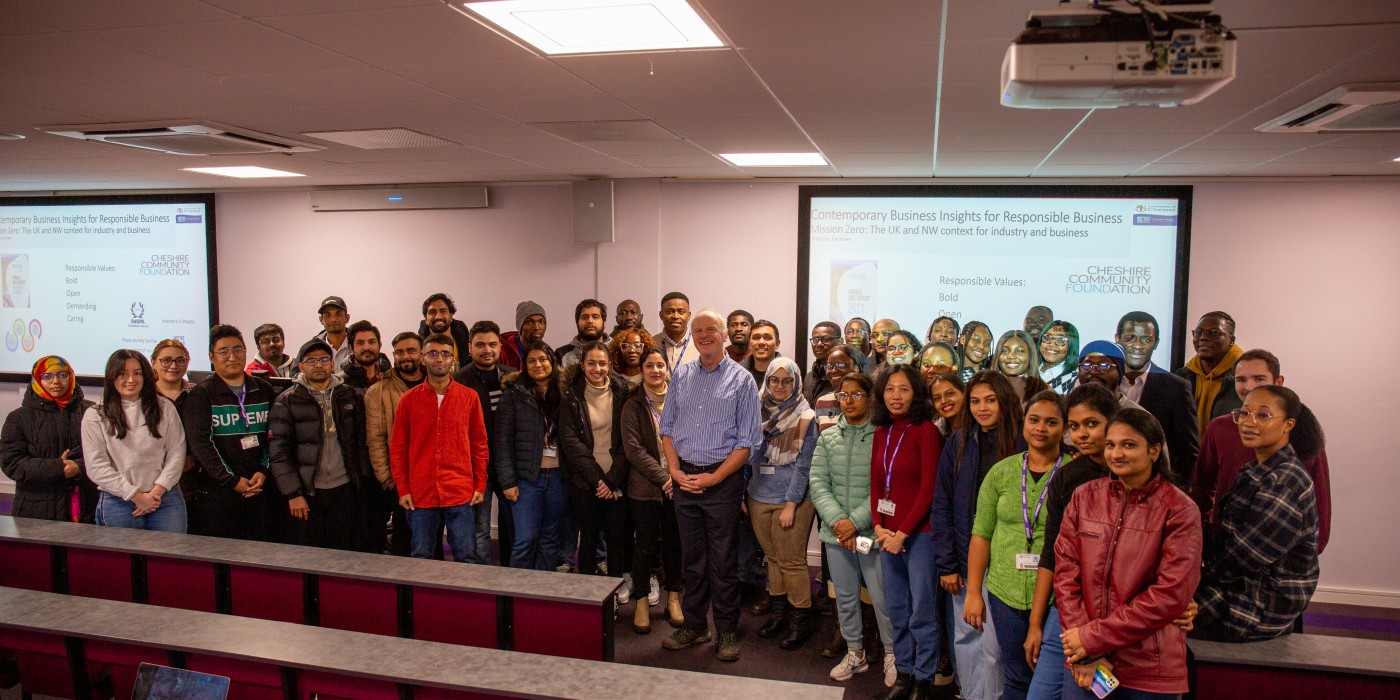
A group of MBA students at an MBA masterclass

The MBA with Specialism in Finance course provides a progression route to Master's level for those who have completed a first degree and who wish to continue with their professional development at an advanced level, with a focus on finance.

At the core of our course is a focus on how best to enable learners to develop advanced capabilities and understanding to make a significant contribution to business and/or professional objectives. Learning opportunities will address the contemporary and future challenges and issues faced by managers, including: the influx of innovative technologies and digital narratives within the global financial environment; diversity and difference; sustainable initiatives; anticipating and creating change; changing demographics and employee expectations; evolving customer/client expectations; the need for intergenerational collaboration; working in flatter organisations and individualisation, staying agile and being ambidextrous.

For effective learning to take place, we implement the concept of the 'reflective practitioner', where we draw on the differing experiences of participants and tutor team as a resource.

This takes place through a systematic process of study, reflection and consideration, to optimise the benefits of learning. Learners will be encouraged to engage in dialogue and discussion and share their ideas and current work experiences with others in the group. The 'process' will involve a range of approaches to facilitate learning, including:

  • dialogue; focusing on a topic or group of related ideas to improve understanding
  • advising; by offering perspective on a best course of action or the nature of the situation
  • viewpoint; offering a range of points of view or standpoints.

It is expected that learners will engage with the curriculum to lead them to new ways of thinking, to evaluate and develop insights and sound analytical and financial management skills and then, where appropriate, to apply the skills and knowledge they acquire on the course by transferring and applying them to the workplace. Assignments are therefore designed to reflect this with learners usually encouraged to work on 'real life' problems/issues, which requires the ability to apply theoretical concepts in practice.

There is an option to choose a Project/Placement year for this course, at an additional cost.


What You'll Study

If you choose a placement or project year, the Management Research in Action module will be replaced by a placement or project module.

Modules

This module integrates advanced leadership theories with ethical management strategies, emphasising the practical skills needed to address complex organisational challenges. It cultivates ethical decision-making, shapes accountable leadership practices, and fosters sustainable and value-driven organisational cultures.

This module provides a critical overview of the core areas of marketing for organisations. It covers key concepts such as customer value, market analysis, and strategic marketing planning.

Students will explore key factors shaping the marketing environment, target marketing and consumer buyer behaviour, the importance and role of positioning and integrated marketing communications with an emphasis on the development and rationale for developing strong brands. Students will also examine the contemporary marketing challenges facing organisations students and how to evaluate marketing strategy.

This module equips students with adequate financial knowledge of corporate finance including investing, financing and dividend decisions in an organisational context. It aims to achieve the following objectives:-

  1. To enable students to explore and develop an understanding of the theoretical techniques, concepts and methods employed in finance
  2. To develop the ability to apply the theoretical to the practical, through the analysis of data and application of relevant techniques in the context of a variety of organisations
  3. To evaluate and develop a critical and reflective awareness of the importance of the application of finance to decision making within organisations

Indicative contents include but are not limited to:

  • Financial accounting – financial reporting/statements/corporate financing/financial control techniques/cash flow management
  • Management and cost accounting – operational/implementation/strategic financial decision making/performance measurement
  • Investment decisions – appraisal/risk/financing/capital rationing/strategy/acquisitions/rationing/strategy/acquisitions and mergers
  • Value based management – shareholder value/valuation/ethical issues

This module aims to equip MBA students with strategic knowledge of corporate finance including investing, financing and dividend decisions in an international context, whilst considering relevant aspects of sustainability as part of the decision making process.

The indicative contents of the module are as follows:

  • External environmental analysis for the organisational ecosystem. 
  • Resources and value creation within the organisational ecosystem.
  • Sustainable finance integrates Environmental, Social, and Governance (ESG) factors into investment decisions, aiming for long-term financial returns alongside positive societal and environmental outcomes.
  • Corporate Investment decisions and International Finance
  • Global Contexts for investment decision making and strategy
  • International context of Corporate Finance planning
  • Capital structure and corporate value
  • Shareholder value - Financial market structures and products
  • The relationship between economic events, interest rates and foreign currency 
  • Workings of the capital and money markets.
  • Financial and strategic implications of organic growth vs mergers and acquisitions.

This module develops MBA students' awareness and understanding of risk management frameworks in international contexts. It covers the nature of financial and non-financial risks and the key components of risk management systems as well as the analysis and application of corporate governance principles in relation to risk management.

Indicative contents are as follows:

  • Corporate governance theories including internal control systems and internal audit.
  • Enterprise risk management frameworks.
  • Strategy risk.
  • Cyber security threats, processes, tools, techniques and reporting.
  • Reputational risk.
  • Economic and credit risk.
  • Interest rate and currency risk in international contexts.

A course of individual study and research project in accordance with established research principles involving the completion of a Management Research Project, usually in the form of a dissertation. 

The module is designed to enable learners to:

  • Be able to identify & justify a Business research "real world" problems, evaluate, and apply appropriate research methods to address the research problem.
  • Design and implement a management research project using methodologies and methods appropriate to
    research questions and objectives
  • Analyse and report business/management research findings to meet academic and practitioner needs
  • Demonstrate critical reflection on the research process, managerial implications and alignment with future study.
  • Demonstrate the application of knowledge and skills to plan a substantial management research project.
  • Assess and evaluate potential ethical and practical challenges to conducting a management research project.
  • Provide students with the skills to develop the work from an existing research proposal into a piece of rigorous management research or an organisation-specific project using secondary or primary data as negotiated with their supervisor
  • To provide students with the skills to write up an extended piece of research, demonstrating academic rigour, including consideration of methodological and ethical issues associated with the programme of academic research or the organisation specific project
  • To enhance students' project planning, presentation, critical reflection, and analysis skills
  • To support students with the opportunity, and the enabling mechanisms to support their development towards
    independent learning.

Indicative content includes, but is not limited to:

  • The nature, extent and purposes of management research
  • Management research paradigms
  • Research strategies
  • Research designs, methods and approaches
  • Research quality standards: establishing validity, reliability and generalisability
  • Sampling and Research instrument design
  • Research ethics
  • Research Data Management: collection, organisation and analysis
  • Managing a dissertation research project

The information listed in this section is an overview of the academic content of the course that will take the form of either core or option modules and should be used as a guide. We review the content of our courses regularly, making changes where necessary to improve your experience and graduate prospects. If during a review process, course content is significantly changed, we will contact you to notify you of these changes if you receive an offer from us.

If chosen, your second year of study will consist of your Project or Professional Placement.

MODULES

  • Professional Placement Option
  • Professional Project Option

The information listed in this section is an overview of the academic content of the course that will take the form of either core or option modules and should be used as a guide. We review the content of our courses regularly, making changes where necessary to improve your experience and graduate prospects. If during a review process, course content is significantly changed, we will contact you to notify you of these changes if you receive an offer from us.

How You'll Learn

An aerial photograph of Exton Park with the text 'How we teach at the University of Chester'

How we teach at the University of Chester

You will learn by attending and engaging with regular, scheduled sessions, which could be lectures, workshops, presentations, guest speaker talks led by industry experts, or case studies, site visits, as well as one-to-one sessions with your tutors. Our Chester MBA with Specialism in Finance is also equipped with bespoke contemporary masterclasses that helps to further develop the knowledge and skills for Financial Managers towards future thinking.

The course is designed to offer a blend of theoretical underpinning and industry thinking, capturing the key units of any business organisation and the financial sector in more depth. These include modules on contemporary leadership, marketing across boundaries, finance for managers, strategic financial management, creative thinking and problem solving for managers. The modules are developed to reflect the importance of sustainability and ethics, in business and management, whilst ensuring that profit, people and the environment are emphasised to ensure that our graduates are responsible and future ready.

As part of this course, you have the opportunity to acquire both leadership and management skills through a variety of teaching and assessment methods. Most modules are designed around in-person study, though some modules may include online learning activities, as a fundamental element of the course. Additionally, learning and teaching will take place through study of key theories, analysis of relevant contemporary case studies using diverse media. Learning will also be gained through broad tutor-directed and student-directed independent extensive reading and research.

Acknowledging the fact that students need to develop the ability and competence to learn independently, the final module has been developed to provide students the opportunity to put their already developed skills through the course journey to use in the final 60-credit management research module.

Students are able to put to use their research, creative and problem solving skills to proffer solutions that will positively inform managerial practice within any business context.

Our MBA Core values:

  • Transformational leadership – driving and inspiring personal and professional impact
  • Ethics and integrity – 'how we do business is just as important as what we do'
  • Reflective action learning – developing 'camaraderie of culture' through collective (including peer-to-peer) learning

These values are embedded within the module titles, content, and assessments. Moreover, they reinforce the wider Faculty values, and other University initiatives, such as the 'Responsible Future' and ethical audit.

Your Future Career

Careers service

The University has an award-winning Careers and Employability service which provides a variety of employability-enhancing experiences; through the curriculum, through employer contact, tailored group sessions, individual information, advice and guidance.

Careers and Employability aims to deliver a service which is inclusive, impartial, welcoming, informed and tailored to your personal goals and aspirations, to enable you to develop as an individual and contribute to the business and community in which you will live and work.

We are here to help you plan your future, make the most of your time at University and to enhance your employability. We provide access to part-time jobs, extra-curricular employability-enhancing workshops and offer practical one-to-one help with career planning, including help with CVs, applications and mock interviews. We also deliver group sessions on career planning within each course and we have a wide range of extensive information covering graduate jobs .

Entry Requirements

2:2honours degree

Applicants will normally be expected to hold a first degree with a minimum of 2:2 honours or equivalent. In addition, it is anticipated that students will be able to demonstrate some form of previous work experience. Where they do not, the University will assess the student’s application carefully for equivalence and, where necessary, the student will be required to engage with appropriate employment-related experience early during their study programme to ensure that relevant skills are embedded in their learning journey.

Applicants whose first language is not English must provide evidence of English language proficiency qualification.

2:2honours degree

Applicants will normally be expected to hold a first degree with a minimum of 2:2 honours or equivalent. In addition, it is anticipated that students will be able to demonstrate some form of previous work experience. Where they do not, the University will assess the student’s application carefully for equivalence and, where necessary, the student will be required to engage with appropriate employment-related experience early during their study programme to ensure that relevant skills are embedded in their learning journey. 

English Language Requirements

For more information on our English Language requirements, please visit International Entry Requirements

Switch combined course content

Optional 2-Year Master's To Suit Your Needs

Choosing a Professional Placement MSc is a win-win for your career, giving you the chance to get real experience, apply your cutting-edge skills in the workplace and stand out to future employers.

In the first year you will have help from the University to find a placement, whilst developing your expertise. You will then spend your second year out in industry on placement, getting the chance to work with industry professionals and grow your network of industry contacts. Bringing the latest business school insights to industry, you will get to make a difference to the workplace and make lasting links with your employer.

Students need to find and secure their own placement, supported by the University. A preparation module will also help you to get ready for your placement.

Please note, this course is available as a one-year master degree course, or as a Two-Year Master's Course with a Professional Placement or Project. Please carefully consider your options when applying for our one year or Two-year routes as successful international applicants will not be able to change between courses after a Confirmation of Acceptance of Studies (CAS) letter has been issued or after arriving in the UK.

Fees and Funding

£14,535for full course (2026/27)

Guides to the fees for students who wish to commence postgraduate courses are available to view on our Postgraduate Taught Programmes Fees page. Here you will also find information about part-time fees and project/placement year fees.

£15,700for full course (2026/27)

Please note: Where a placement or project year is undertaken, there will be an additional charge of £2,900 for the placement/project year (due at the start of the second year of the course).

The University of Chester offers generous international and merit-based scholarships for postgraduate study, providing a significant reduction to the published headline tuition fee. You will automatically be considered for these scholarships when your application is reviewed, and any award given will be stated on your offer letter.

For more information, go to our International Fees, Scholarship and Finance section.

Irish Nationals living in the UK or ROI are treated as Home students for Tuition Fee Purposes.

Your course will involve additional costs not covered by your tuition fees. This may include books, printing, photocopying, educational stationery and related materials, specialist clothing, travel to placements, optional field trips and software. Compulsory field trips are covered by your tuition fees. 

The University of Chester supports fair access for students who may need additional support through a range of bursaries and scholarships. 

Full details, as well as terms and conditions for all bursaries and scholarships can be found on the Fees and Finance section of our website.

Who You’ll Learn From

Dr Trevor Omoruyi

Senior Lecturer
Trevor Omoruyi

Stuart Paul

Programme Leader for MSc Marketing Management
Stuart Paul

Dr Farid Ullah

Associate Professor Programme Leader for International Business MSc
Dr Farid Ullah

Andy Lewis

Visiting Lecturer
Andy Lewis

Karen Cregan

Senior Lecturer in Human Resources & Business Management
Karen Cregan

Enquire about a course