Publishing and Sharing Research
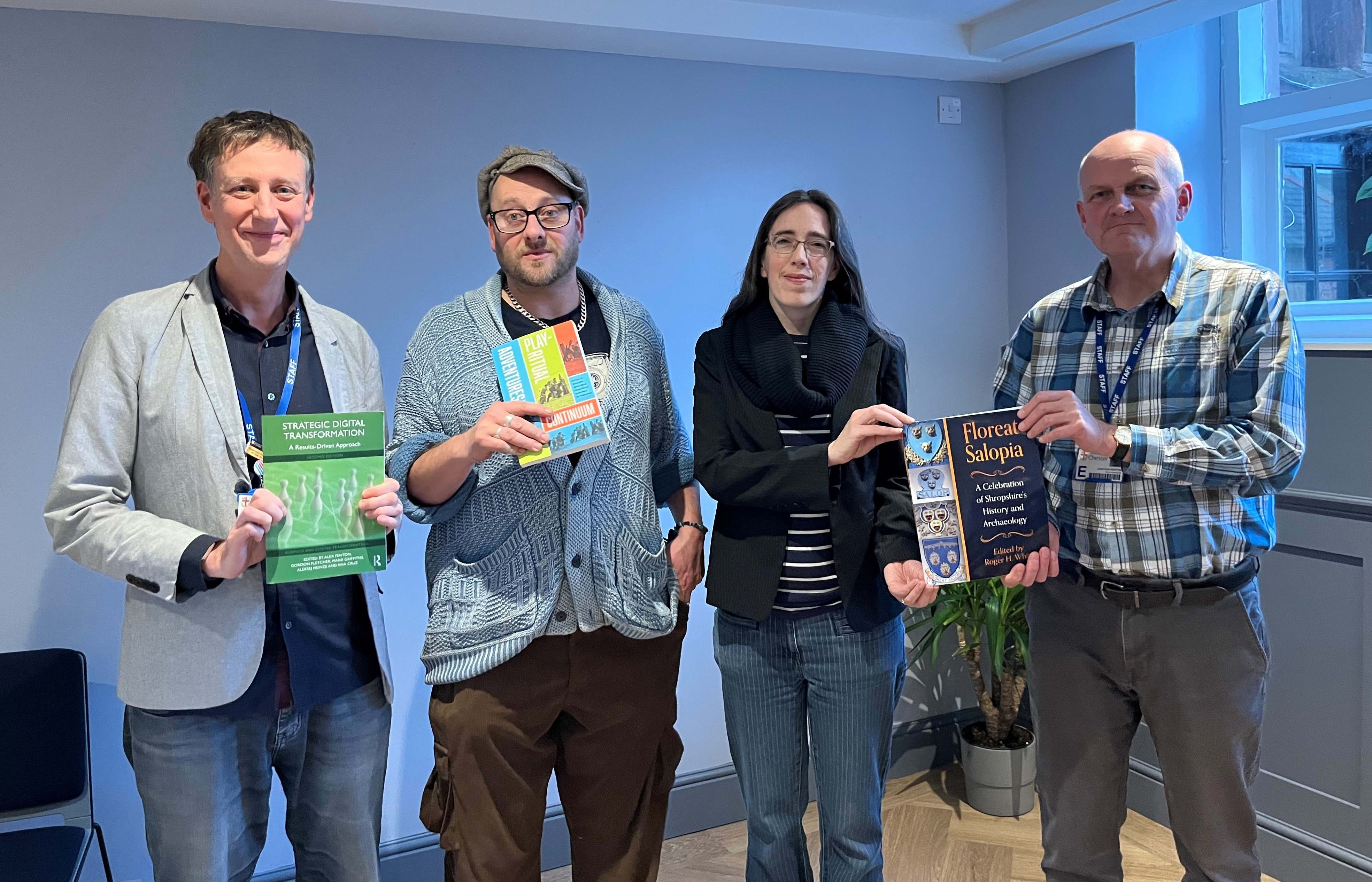
This page offers guidance on publishing and sharing research, including essential information on copyright.
Guidance on Publishing
University guide to publishing
The University of Chester's LIS Research Support Team have produced a comprehensive guide which is useful for those new to publishing as well as those with more experience. The guide advises on:
- Publishing a journal article or conference paper
- Publishing a book or chapter
- Avoiding predatory journals and publishers
- Responsible authorship and fair attribution
- Open Access policies and practices
- The storage and management of publications.
Read the University guide to publishing [University login required].
The Role of Author Identifiers
Due to the volume of researchers currently publishing, it can be hard to link them with their papers. Author identifiers make this process easier because they:
- Ensure authors receive credit for their work
- Eliminate confusion with other researchers who have an identical or similar name
- Are not tied to a particular institution or role, so they can be used throughout a researcher’s career.
Author identifiers are often accompanied by a profile that displays other useful information, such as citation counts. Some profiles are largely curated automatically (e.g. those in indexing databases) whereas others allow for more manual input (e.g. ORCID).
The author identifiers listed below are integrated with Symplectic Elements, the University’s Current Research Information System (CRIS). This means that papers associated with a known identifier will automatically be imported into an Elements profile, making it easier for you to display, manage and deposit newly published outputs.
Sharing Research on Networking and Social Media Platforms
ResearchGate and Academia.edu are commercial platforms that enable researchers to forge connections and showcase their publications. Users can create a profile, list their outputs and in some cases, share manuscripts. However, copyright considerations are crucial. Before uploading work, you must check whether sharing the manuscript is permitted. If a publication is not Open Access, the final published version cannot be shared openly.
If you are unsure, contact LIS Research Support (researchsupport.lis@chester.ac.uk) or use the Request Full Text feature to share work privately with specific individuals.
Why institutional repositories are better than academic networking sites for depositing and sharing work
Academic networking sites should complement, not replace, institutional repositories, such as ChesterRep. Institutional repositories offer several key advantages. These include the fact that they are:
- Officially recognised by funders, publishers and governments.
- Essential for compliance with funder and REF Open Access requirements.
- Curated by librarians, who check publisher permissions and reduce copyright risk.
- Permanent, secure and not-for-profit, unlike the commercially run academic networking sites, which may change or discontinue services depending on profits. Furthermore, some publishers do not permit work to be commercially shared, making it trickier to share on an academic networking site.
Sharing research on social media
Social media platforms allow researchers to engage with academic and non-academic audiences. They can also extend the reach of their research, demonstrate impact and create collaboration opportunities.
Microblogging
Researchers can ‘microblog’ about their research on platforms like X (formerly Twitter), which limits posts to 280 characters. X is particularly useful for taking part in academic discussions, following conferences and connecting with editors. However, many academics have chosen to leave X in recent years and joined an alternative microblogging platform called BlueSky. It looks very similar to Twitter but has additional features for networking and lacks an algorithm (the general feed simply shows posts from people you follow, in date order). New users can follow curated groups of users known as Starter Packs, which help get a profile off the ground. Other features, such as custom feeds (compiled sets of posts on a specific topic, subject or theme), introduce new users to other researchers with similar interests.
In order to get the most out of social media, tips include:
- Tagging journals (in which your papers are published), collaborators and institutions.
- Using hashtags linked to the research or the post’s content.
- Resharing and reposting content, especially if a topic is trending or appears in the news.
- Asking a question to your audience/followers which can spark a conversation.
- Including a link to your published work (on the publisher’s website). From a copyright perspective, this is safer than uploading the document itself.
Copyright for Researchers
Copyright protects the intellectual property of researchers and provides the legal framework for the ethical sharing of research. The information below offers basic information and guidance for students and staff. If you have a specific query on copyright in your research, please contact LIS Research Support (researchsupport.lis@chester.ac.uk).
You can also consult the University's internal guidance on Portal [University login required].
Copyright and Doctoral Theses
Students are normally the copyright holders of any research outputs, including theses, produced whilst at the University of Chester. Whilst the University encourages the use of freely accessible material, it is possible that you may need or want to use third-party copyrighted material (e.g. images, maps, tables, long extracts etc.) in your thesis. This will need to be cleared before the thesis and any related outputs can be made available. The information below offers advice on what you need to consider if your thesis (or dissertation) contains copyrighted material.
Use of third-party copyrighted material
Before a thesis is sent to LIS Research Support for deposit, you should check whether you have used any copyrighted material and, if so, seek permission from the copyright holder to use it in your thesis.
If a thesis contains material from journal articles, the publisher may use the Copyright Clearance Center (CCC) service to manage requests relating to copyright and the reuse of material in a specific article. Applications to reuse material can be made via the permission, reuse and/or rights link on the webpage record of the article. You can also to contact the publisher's permissions and rights department.
If a thesis includes material from museums, galleries or archives, it may be covered by a blanket licence for reuse in research. Contact the institution and ask for advice.
If permission cannot be sought, two options are available, namely to:
- Redact (remove) the copyrighted material and make the thesis openly available.
- Retain the copyrighted material, but apply a permanent embargo (restricted access) to the thesis.
Making research openly available is the default expectation at the University of Chester. It may also be necessary if doctoral research is funded by a funder with Open Access (OA) requirements, e.g. the UKRI. However, applying a permanent embargo may be the only solution if third-party material cannot be redacted. This might arise if the copyrighted material has been heavily analysed or critiqued, so its omission would look odd and seriously impede meaning.
Publishing from your thesis prior to submission
When you publish work prior to the submission of your thesis, review the terms of the publishing contract carefully. If you have signed a contract assigning copyright to the publisher, you may not be able to reproduce the material in your thesis without contacting the publisher for permission. The University therefore recommends that students:
- Publish OA whenever possible. Check whether the paper is eligible for financial support if the payment of an Article Processing Charge (APC) is required. Please refer to the University's Transformative Agreements or get in touch with LIS Research Support.
- Publish under one of the Creative Commons licences (the University recommends the CC BY licence) which provide permissions for reuse.
Publishing from your thesis post submission
Most publishers do not view a thesis as a prior publication. It is therefore not necessary to apply an embargo to your thesis on the University's repository, ChesterRep, if you plan to publish articles in the future that are based on your thesis. However, it is worth checking the policies of the publisher and/or journal, as some may have specific requirements, such as an acknowledgement that the research was undertaken as part of your PhD. Examples of publishers who do not view a thesis as a prior publication are Elsevier, Oxford University Press, PLOS, Taylor & Francis, Springer Nature, Wiley, Institute of Physics and the Royal Society of Chemistry (this is not an exhaustive list). In cases of uncertainty, contact LIS Research Support before submitting a manuscript.
If you plan to turn your thesis into a monograph (book), it is recommended that you apply an embargo to your thesis on ChesterRep. It should be long enough to stretch to the potential publication date of the monograph.
An embargo is requested via a thesis deposit form, which must be completed and signed by the student, supervisor and Personal Academic Tutor (PTA) before the thesis can be added to ChesterRep by LIS Research Support. You can apply to extend an embargo at a later date, but you will need to complete a new deposit form. You cannot apply an embargo to a thesis that has already been openly available.