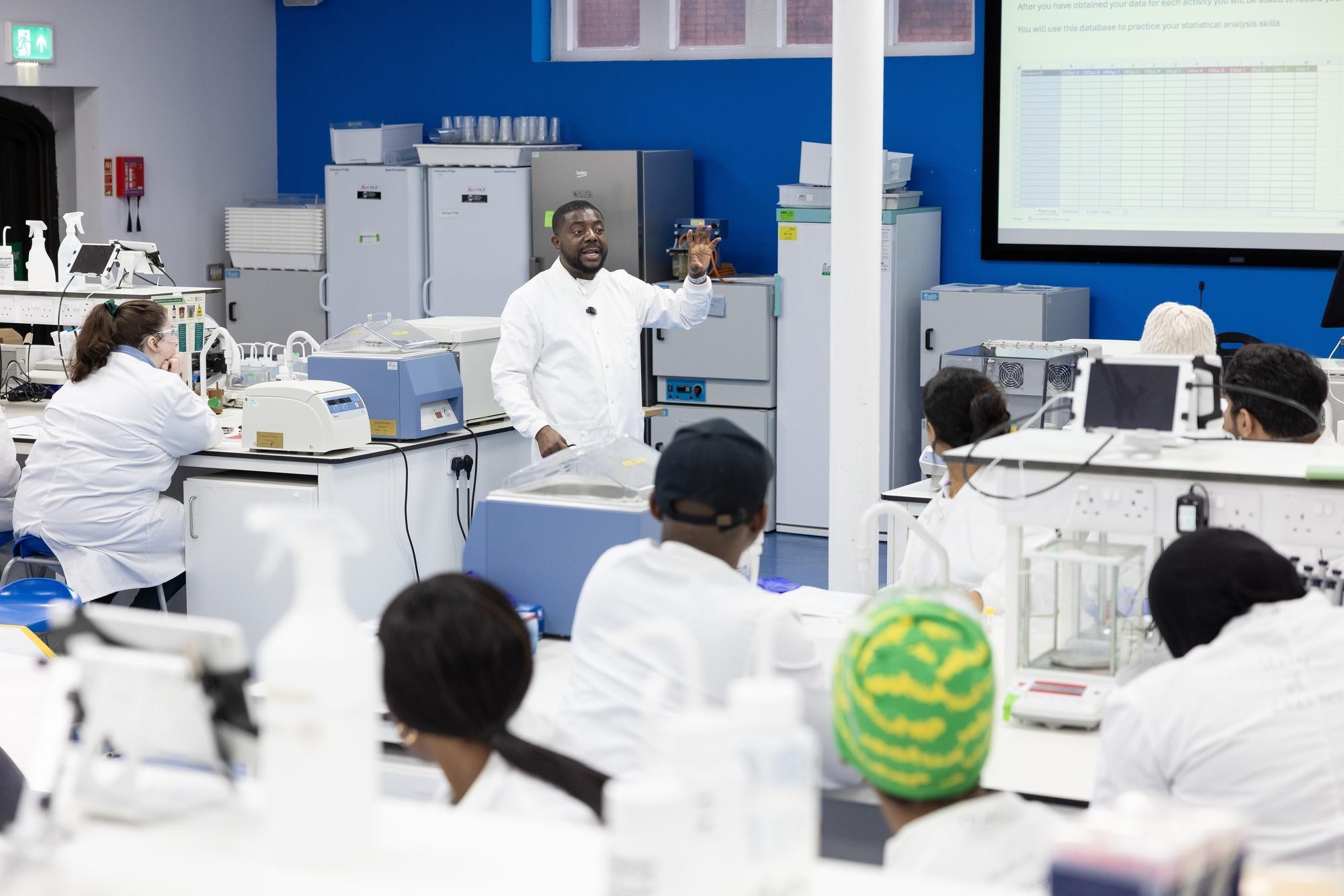




Biomedical Science session

Develop advanced knowledge in disease mechanisms, diagnosis, treatment and recent biomedical research.

Biomedical Scientists are essential members of the modern healthcare team and, in collaboration with doctors and other medical professions, aid in diagnosis of disease, evaluate effectiveness of treatment, and research into causes and cures of diseases. This Institute of Biomedical Science accredited course is ideal for those wanting to develop advanced knowledge and skills in Biomedical Science.

Biomedical Scientists are in demand in the healthcare service (NHS pathology labs, National Blood and Transplant Service), medical research, pharmaceutical industry, and organisations such as the UK Health Security Agency and the Medical Research Council.

You will receive training in the skills required in the reading and interpretation of the literature and translating that into evidence-based practice. We aim to develop your research and writing skills so that you will be in a position to contribute to the scientific literature in an effective manner.

The course culminates in the Research Dissertation, which will be assessed through your production of a research article written in the style of publishable scientific work and a short oral presentation. Options could include data or laboratory-based projects, depending on research interests.

Successful completion of this MSc Biomedical Science course can lead to a range of exciting career and research opportunities, including careers in biomedical or clinical research, medicine, physician associate, PhD study or teaching.

Find out more about International Scholarships

Accreditations

Institute of Biomedical Science logo

Why You'll Love It

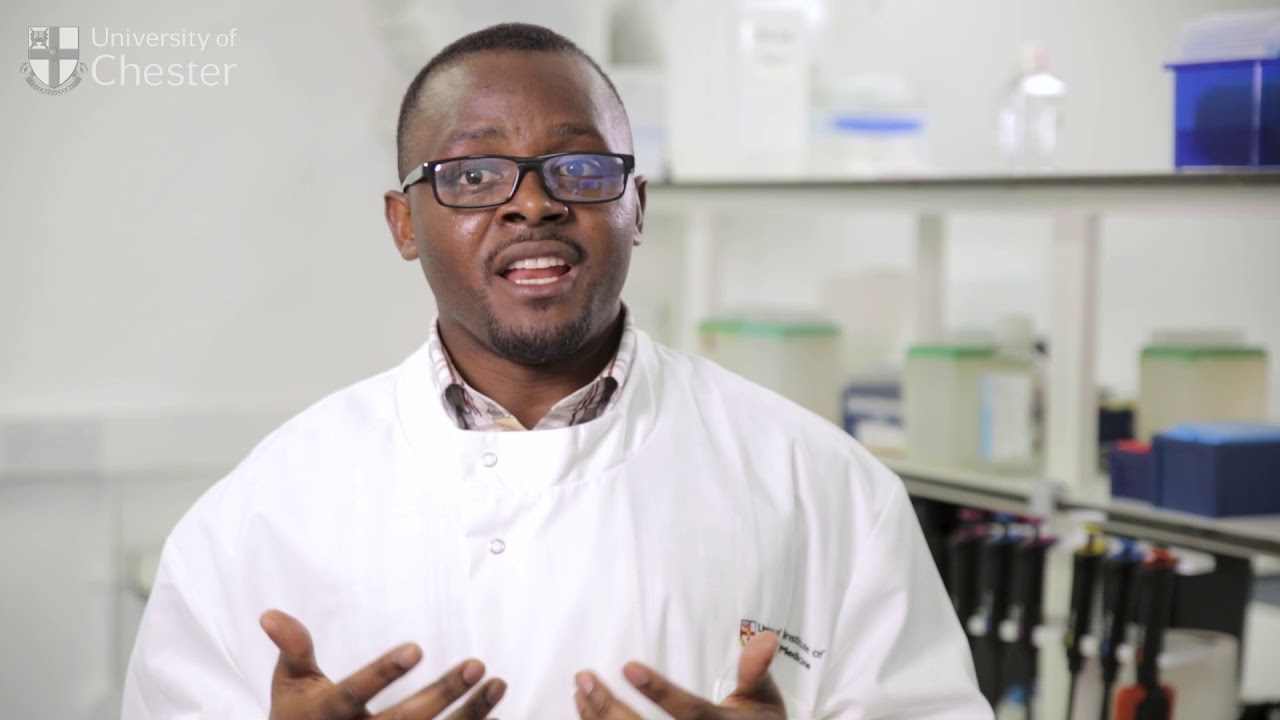
Francis’ Biomedical Science Experience

Francis’ Biomedical Science Experience

What You'll Study

Our modules cover a wide range of scientific subjects, including all the major disciplines of biomedical science – i.e. cellular pathology, clinical chemistry, clinical medicine, blood science, histology, immunology, and medical microbiology. The course consists of taught modules and a research dissertation.

Core Modules

Module Aims

The module aims to equip students with the skills required to source and critically analyse relevant research and to apply the theories of evidence based medicine to evaluate relevant concepts in medicine.  

Module Content

  • The nature of research; scientific methods of enquiry, pure versus applied ways of problem solving. The building blocks of scientific research: types of research (analytical, descriptive, experimental, and qualitative), scientific parlance (hypothesis, concepts, operational definitions, and dependent/independent variables), sampling procedures, and measurement issues (reliability and validity)

  • Research and data collection methods: experimental research (developing hypotheses, variables, control, sample selection, design, validity); descriptive research (questionnaires, correlational studies); qualitative research and methods of obtaining qualitative data and analysing qualitative data

  • Critical appraisal of literature- primary and secondary literature.

  •  Importance of evidence based medicine; identifying a topic area, devising specific questions, discovering what is already known (reviewing the literature), determining feasible ways to answer the questions, including consideration of medical and research ethics and confidentiality

Module Aims

  • Develop an understanding of the theories underpinning modern analytical and molecular techniques of relevance to the biomedical and molecular laboratory scientist.
  • Develop a critical appreciation of the uses and limitations of a range of analytical and molecular techniques relevant to the biomedical and molecular sciences through practical experience.
  • Develop skills in collection, analysis, presentation and interpretation of data. 

Module Content

Students will gain an appreciation of aspects of data collection and analysis through lectures , practicals and computer-based sessions covering:

  • The sample – collection, transport, storage 
  • The assay – assay development, method validation, precision, accuracy, specificity, sensitivity
  • Regulatory issues - quality control, SOPs, COSHH, risk assessments 
  • Analysis – recording, raw data presentation, statistical analysis using statistics software, summary data and statistical analysis presentation, reference values, interpretation.

Students will gain experience of a number techniques of relevance to their programme and may include:

  • Gel electrophoresis & Western blotting
  • Flow cytometry
  • Molecular biology techniques (e.g. PCR)
  • Immunoassays (e.g. ELISA)
  • Histology & microscopy 
  • Culturing methods – cell culture, culturing bacteria
  • Cell counting methods


Module Aims

The module aims to provide students with an in-depth knowledge of concepts important to our understanding of patient journey in NHS process. The module will focus on the impact of diagnostical procedures on treatment protocol in different pathologies. 


Module Content

This module is focused on the precision medicine approach, looking systematically at a bigger picture of a patient journey from a presentation to NHS with first symptoms to the treatment protocol passing the diagnostic process.

Students will focus on diseases or elements of the pathology or system of relevance to their programme.

Module Aims

The module aims to provide students with an in-depth understanding of current issues and developments in Biomedical Science, and of the associated professional and regulatory bodies.

Module Content

  • Institute of Biomedical Science (IBMS)
  • Health and Care Professions Council (HCPC)
  • IBMS Degree Accreditation
  • Biomedical Scientists and Clinical Scientists
  • Continuing Professional Development (CPD)
  • Healthcare Scientists (NHS Scientist Training Programme, Higher Specialist Scientist Training)
  • Careers in Biomedical Science
  • Medical Laboratory Accreditation/ United Kingdom Accreditation Service (UKAS)
  • Human Tissue Authority (HTA)
  • Medicines and Healthcare products Regulatory Agency (MHRA)
  • Clinical governance
  • Laboratory quality management systems
  • Laboratory information management systems
  • Laboratory automation
  • Digital pathology
  • Point-of-care testing
  • Pathology networks

Module Aims

This module will focus on laboratory tests and analyses performed in the Blood Science laboratories, for the diagnosis and management of patients with a variety of conditions.

Module Content

Here we will discuss a selection of tests from a variety of laboratories including haematology, coagulation, transfusion, and biochemistry. The Haemato-oncology Diagnostic Service (HODS) departments (Immunophenotyping and Molecular) are also covered to provide a well-rounded understanding of the investigations that underpin modern patient screening, diagnosis and monitoring of disease.

We will discuss the diagnosis of a variety of disorders such as haematological malignancies, non-malignant haematological disorders, renal disorders, liver disease, and clinical disorders of lipid metabolism.

Aims:

The module aims to allow students to develop an understanding of the immunological processes involved in various aspects of clinical immunology (e.g. autoimmune diseases, hypersensitivity, transplantation) and to develop an in-depth understanding of the interactions between pathogens and the human host.

Module content:

Discussion of clinical immunology, including:

  • Immune mediated disorders (e.g. mechanism of autoimmunity, hypersensitivity reactions, immunological markers of disease – flow cytometry & ELISA, cytokines)
  • Transplantation immunology (HLA polymorphism, HLA function, anti-rejection therapy, graft versus host disease)
  • Pathogenesis of infectious disease
  • Aspects of infection/host parasite interaction
  • Parasitology
  • Medical mycology
  • Chemotherapy and immunotherapy
  • Epidemiology of infectious disease
  • Diagnosis of infectious disease

Module Aims

  • To provide the student with an opportunity to investigate a research project of direct relevance to the programme of study and his/her personal interests.
  • To enable the student to draw on and contribute to the development of the growing body of knowledge in the broad biomedical, clinical and medical science fields.
  • To present the outcomes of the research performed in the form of a research article in a format ready for submission to a suitable journal and as an oral presentation 

Module Content

On completion of the taught modules, students will have developed their knowledge base and attained a high level of competence in the application, analysis and evaluation of theory and practice. This knowledge and critical skills will have been assessed in all previous assignments, thereby providing students with the opportunity to undertake a research project relevant to their taught programme of study. The dissertation subject will be agreed with an appropriate supervisor and the dissertation module leader (Dissertation Co-ordinator). The subject matter may be related to any area of relevance to the area of study.

The information listed in this section is an overview of the academic content of the course that will take the form of either core or option modules and should be used as a guide. We review the content of our courses regularly, making changes where necessary to improve your experience and graduate prospects. If during a review process, course content is significantly changed, we will contact you to notify you of these changes if you receive an offer from us.

How You'll Learn

An aerial photograph of Exton Park with the text 'How we teach at the University of Chester'

How we teach at the University of Chester

Teaching, learning and assessment will be delivered over a 10-week teaching block with two 20-credit modules (40 credits in total) running per term. During this 10-week period, the contents of both 20-credit modules (including support provision, learning materials and assessment details) will be delivered. In addition, laboratory-based practical work, which contributes to the learning outcomes of some modules, will be undertaken within the period. A diverse range of teaching and learning modes are utilised for this programme (lectures, seminars, group activities, case studies, student presentations, laboratory work, and online asynchronous activities). Students are expected to attend teaching 2 days per week – one day per module within the 10-week period. However, for modules that has practical contents (e.g. MD7002), the hours proposed for each week will be exceeded on the week(s) the practical sessions will be run. Students will be encouraged to participate in independent learning following lectures and practical sessions to establish self-help groups (study groups, email communication, social media or discussion boards). 

Your Future Career

Job Prospects 

MSc Biomedical Science graduates have a wide range of prospects available to them. Many students use the degree to advance their career as HCPC registered practising Biomedical Scientists, working in the National Health Service. Graduates also move into pharmaceutical industries or continue their research interests and complete their PhD. 

Careers service

The University has an award-winning Careers and Employability service which provides a variety of employability-enhancing experiences; through the curriculum, through employer contact, tailored group sessions, individual information, advice and guidance.

Careers and Employability aims to deliver a service which is inclusive, impartial, welcoming, informed and tailored to your personal goals and aspirations, to enable you to develop as an individual and contribute to the business and community in which you will live and work.

We are here to help you plan your future, make the most of your time at University and to enhance your employability. We provide access to part-time jobs, extra-curricular employability-enhancing workshops and offer practical one-to-one help with career planning, including help with CVs, applications and mock interviews. We also deliver group sessions on career planning within each course and we have a wide range of extensive information covering graduate jobs and postgraduate study.

Entry Requirements

Honours Degree

Applicants should normally have an honours degree (minimum 2:2) containing a significant content of biomedical science, or hold appropriate professional qualifications and be able to demonstrate suitable background knowledge and skills.

Extra Requirements

Applicants can be:

1. Those with related undergraduate degrees (e.g. Biomedical Science, Medical Laboratory Science, Human Biology) or equivalent professional qualifications and background experience
2. NHS staff
3. International students with appropriate qualifications
4. International healthcare professionals.

Interview

Potential students may be invited to attend for interview

IELTS

6.5 (Min 5.5 in each sub-skill)

Honours Degree

Applicants should normally have an honours degree (minimum 2:2) containing a significant content of biomedical science, or hold appropriate professional qualifications and be able to demonstrate suitable background knowledge and skills.

Extra Requirements

Applicants can be:

1. Those with related undergraduate degrees (e.g. Biomedical Science, Medical Laboratory Science, Human Biology) or equivalent professional qualifications and background experience
2. NHS staff
3. International students with appropriate qualifications
4. International healthcare professionals.

Interview

Potential students may be invited to attend for interview

Fees and Funding

£9,090 for a full-time course (2026/27)

The tuition fees for international students studying programmes in 2026/27 are £9,090 per year.

£15,500 (2026/27)

The tuition fees for international students studying programmes in 2026/27 are £15,500 per year.

Who You'll Learn From

Enquire about a course