
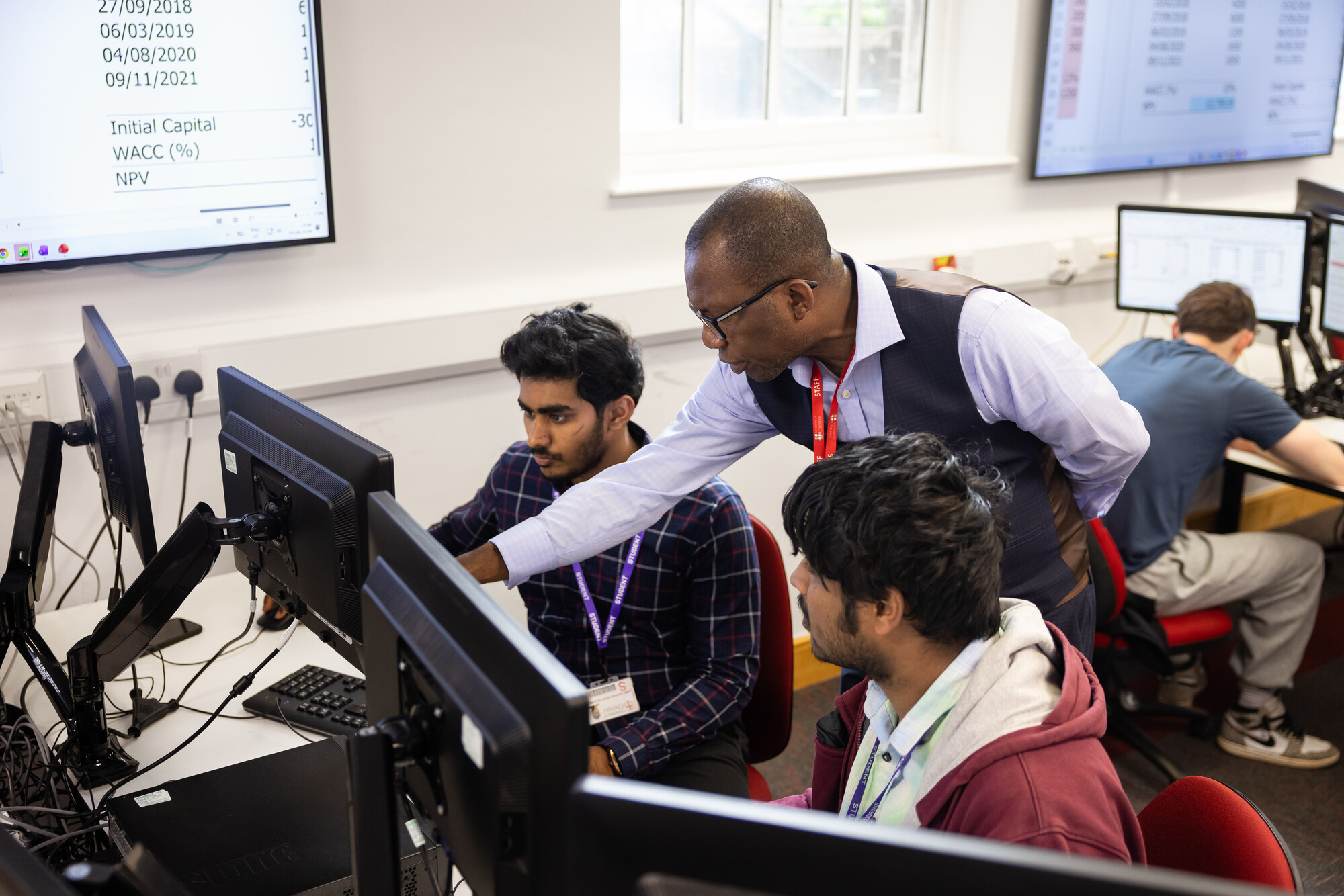



Two students sitting at computer screens in the Fintech Suite

Course Overview

Read summary

Economics and FinTech BSc Hons at Chester:

  • will enable you to develop analytical, quantitative, digital, and problem-solving skills alongside professional, ethical, and intercultural awareness
  • places a strong emphasis on employability and professional development, including dedicated employability modules
  • will prepare you for a career in financial services, FinTech organisations, banking, investment analysis, economic consultancy, business intelligence, policy analysis, data analytics, or related sectors.

The Economics and FinTech BSc (Hons) course equips you with a comprehensive understanding of:

  • economic theory
  • financial systems
  • quantitative analysis
  • emerging technologies that are transforming the global financial sector.

Our curriculum is designed to develop graduates who can critically analyse economic and financial challenges, apply advanced analytical techniques, and leverage innovative technologies to support decision-making in an increasingly digital economy.

The course begins by establishing a strong foundation in microeconomics and macroeconomics, enabling you to understand how markets, institutions, businesses, and governments interact within national and international contexts.

You are also introduced to the principles of Financial Technology (FinTech), exploring the impact of digital innovation on financial products, services, and business models. Quantitative methods provide the mathematical and statistical tools necessary for analysing financial data and supporting evidence-based decision-making.

The curriculum places a strong emphasis on employability and professional development. Dedicated employability modules enable you to reflect on your skills, career aspirations, and professional identity, while opportunities for work placement allow you to apply your knowledge in real-world organisational settings. You will also develop broader professional competencies through optional study in areas such as organisational behaviour and people management, and may enhance your global outlook through the study of a modern foreign language.

In the final stage of the course, you will integrate your learning through advanced modules in economics, FinTech, and data analysis for decision-making.

Our curriculum fosters intellectual curiosity, adaptability, and lifelong learning, preparing graduates to contribute responsibly to the future of financial services and economic development.

The course also provides a strong foundation for postgraduate study and professional development in economics, finance, technology, and interdisciplinary fields.

In Year 1, you'll study at Exton Park, enjoying new Business teaching spaces and the full benefits of the University's central campus. In Years 2 and 3, you'll move to Queen's Park, home to our award-winning Business School.


Course Highlights

Course Content

The Economics part of the course is underpinned by an incremental approach to learning, starting with Introductory Micro and Macroeconomics in Year 1 and finishing with Advanced Micro and Macroeconomics in Year 3. This element is supported by a range of highly contemporary, specialised and technical FinTech modules (some of this teaching will be delivered using the FinTech Labs).

The information listed in this section is an overview of the academic content of the course that will take the form of either core or option modules and should be used as a guide. We review the content of our courses regularly, making changes where necessary to improve your experience and graduate prospects. If during a review process, course content is significantly changed, we will contact you to notify you of these changes if you receive an offer from us.

The information listed in this section is an overview of the academic content of the course that will take the form of either core or option modules and should be used as a guide. We review the content of our courses regularly, making changes where necessary to improve your experience and graduate prospects. If during a review process, course content is significantly changed, we will contact you to notify you of these changes if you receive an offer from us.

The information listed in this section is an overview of the academic content of the course that will take the form of either core or option modules and should be used as a guide. We review the content of our courses regularly, making changes where necessary to improve your experience and graduate prospects. If during a review process, course content is significantly changed, we will contact you to notify you of these changes if you receive an offer from us.

Teaching and Assessment

You will learn through a mixture of:

  • taught face-to-face lectures
  • group work
  • presentations
  • self-directed learning outside of the classroom environment.

Class sessions will include:

  • tutor presentations
  • individual exercises
  • group case study work
  • group problem solving work
  • extensive class discussions.

All class materials will be available on the Virtual Learning Environment of the University. It is also worth noting that, extensive reading of texts and journals will be required as befits degree-level modules. You will be given tutor guidance and direction in navigating the required resources linked to this course.

The value of developing your ability to work and learn on your own is recognised. The skill set required for meeting this need has been accordingly embedded within the modules of this course. Again, to facilitate the development of this, emphasis is placed on shared responsibility for learning, on the importance of independent work to support the tutor-led sessions and on student self-directed learning.

You will also be taught in a social, inclusive, flexible and accessible learning environments, using online tools in classrooms and other subject-specific spaces and locations.

Finally, your independent learning is particularly developed within the 40-credit dissertation, and it is appropriate that this element occurs in the latter half of the course. You would have had the opportunity to develop appropriate academic skills, knowledge and understanding in the earlier stages of the course to meet this requirement.

You will be assessed in authentic ways that motivate, and both support your wellbeing and future employer or professional expectations. This is a strategy to develop your future-focused skills to meet your diverse personal and professional ambitions.

Career Prospects

Careers Service

Careers and Employability support at the University of Chester helps you plan your future, make the most of your time at university and enhance your graduate prospects.

We provide access to part-time jobs, extra-curricular employability-enhancing workshops and practical one-to-one help with career planning, including help with CVs, applications and mock interviews.

Support goes well beyond graduation at Chester, offering lifelong careers advice and graduate support, so you won’t just leave with a degree – you’ll leave prepared, connected and ready for success.

Academic Staff

Dr Paul Cowley

Senior Lecturer
profile picture of lecturer Dr Paul Cowley

Entry Requirements

112UCAS points

UCAS Tariff

112 points

GCE A Level

Typical offer – BCC-BBC

BTEC

BTEC Extended Diploma: DMM

International Baccalaureate

28 points

Irish / Scottish Highers

Irish Highers - H3 H3 H3 H3 H4

Scottish Highers - BBBB

Access requirements

Access to HE Diploma, to include 45 credits at level 3, of which 30 must be at Merit or above

T Level

Merit

OCR Cambridge Technicals

OCR Extended Diploma: DMM

Extra Information

Welsh Baccalaureate Advanced and A level General Studies will be recognised in our offer. We will also consider a combination of A Levels and BTECs/OCRs.

Interview

All applicants will complete a standard application form and may be invited to attend an informal interview when feasible to do so.

Students from outside the UK are expected to hold qualifications broadly equivalent to UK standards - typically A Level for undergraduate study.

To help you interpret these equivalents, please select your country/region of residence. This will provide details on equivalent entry requirements, as well as information about local representatives, events, and key contacts.

We accept a wide range of qualifications and assess all applications on an individual basis. Relevant work experience may also be taken into consideration where appropriate.

For more information on English entry requirements, including accepted qualifications, please visit International Entry Requirements.

English Language Requirements

IELTS

IELTS Academic: Undergraduate: 6.0 (minimum 5.5 in each band)

Fees and Funding

£9,790per year for a full-time course (2026/27)

Tuition fees for Home students for the academic year 2026/27 will be £9,790 for full-time students and £7,335 for part-time students (subject to Parliamentary approval). Fees for subsequent years may be subject to increase in line with the Government fee cap.

You can find more information about undergraduate fees on our Fees and Finance pages.

Students from the UK, Isle of Man, Guernsey, Jersey and the Republic of Ireland are treated as Home students for tuition fee purposes.

Students from countries in the European Economic Area and the EU will pay International Tuition Fees.

Students who have been granted Settled Status may be eligible for Home Fee Status and if eligible will be able to apply for Tuition Fee Loans and Maintenance Loans.

Students who have been granted Pre-settled Status may be eligible for Home Fee Status and if eligible will be able to apply for Tuition Fee Loans.

£14,950*per year for a full-time course (2026/27)

The tuition fees for international students studying Undergraduate programmes in 2026/27 are £14,950 per year for a full-time course. This fee is set for each year of study.

The University of Chester offers generous international and merit-based scholarships, providing a significant reduction to the published headline tuition fee. You will automatically be considered for these scholarships when your application is reviewed, and any award given will be stated on your offer letter.

For courses with a Foundation Year, the tuition fees for Year 1 are £11,250 and £14,950 for Years 2-4 in 2026/27.

For more information, go to our International Fees, Scholarship and Finance section.

Irish Nationals living in the UK or ROI are treated as Home students for Tuition Fee Purposes. 

Your course will involve additional costs not covered by your tuition fees. This may include books, printing, photocopying, educational stationery and related materials, specialist clothing, travel to placements, optional field trips and software. Compulsory field trips are covered by your tuition fees. 

If you are living away from home during your time at university, you will need to cover costs such as accommodation, food, travel and bills.

The University of Chester supports fair access for students who may need additional support through a range of bursaries and scholarships. 

Full details, as well as terms and conditions for all bursaries and scholarships can be found on the Fees and Finance section of our website.

Connectwith us