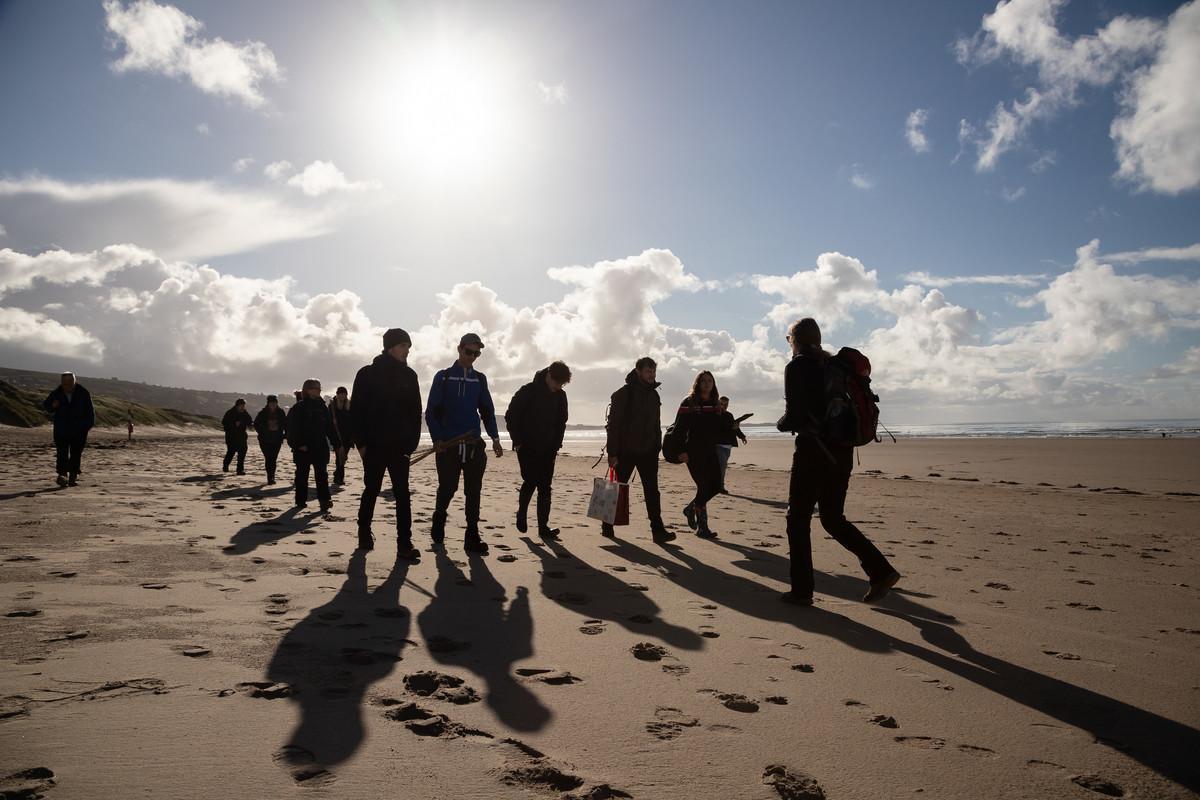


Geography students on a coastal field trip, walking together along a sandy beach under a bright sky.

The BSc in Environmental Science is grounded in a conviction that the environmental challenges of the 21st century – climate change, biodiversity loss, water and air quality, soil degradation, the energy transition, and the just management of land – are inherently interdisciplinary in nature, and that the graduates best placed to address them combine rigorous scientific training with strong analytical and applied skills, an understanding of policy and governance contexts, and a capacity for ethical, evidence-led judgement.

The course philosophy rests on four interlocking commitments:

  • First, that environmental science is a problem-driven discipline: you will learn the underpinning physical, chemical and biological processes through your application to real environmental questions, rather than as decontextualised theory.

  • Second, that field- and laboratory-based learning are the foundations of scientific competence: you will develop confidence and proficiency by handling instruments, sampling environments, working with messy data, and making independent judgements about evidence.

  • Third, that data fluency (particularly in geographical information systems (GIS), remote sensing, environmental modelling and emerging AI-supported analytical techniques) is now a defining capability of an environmental scientist, not an optional add-on.

  • Fourth, that environmental science cannot be taught in isolation from the social, political and economic systems within which environmental decisions are made; you will therefore be expected to develop the ability to communicate with non-specialists, work with stakeholders, and understand the regulatory and policy frameworks that govern environmental practice.

Why You'll Love It

What You'll Study

The information listed in this section is an overview of the academic content of the course that will take the form of either core or option modules and should be used as a guide. We review the content of our courses regularly, making changes where necessary to improve your experience and graduate prospects. If during a review process, course content is significantly changed, we will contact you to notify you of these changes if you receive an offer from us.

The information listed in this section is an overview of the academic content of the course that will take the form of either core or option modules and should be used as a guide. We review the content of our courses regularly, making changes where necessary to improve your experience and graduate prospects. If during a review process, course content is significantly changed, we will contact you to notify you of these changes if you receive an offer from us.

The information listed in this section is an overview of the academic content of the course that will take the form of either core or option modules and should be used as a guide. We review the content of our courses regularly, making changes where necessary to improve your experience and graduate prospects. If during a review process, course content is significantly changed, we will contact you to notify you of these changes if you receive an offer from us.

The information listed in this section is an overview of the academic content of the course that will take the form of either core or option modules and should be used as a guide. We review the content of our courses regularly, making changes where necessary to improve your experience and graduate prospects. If during a review process, course content is significantly changed, we will contact you to notify you of these changes if you receive an offer from us.

How You'll Learn

An aerial photograph of Exton Park with the text 'How we teach at the University of Chester'

How we teach at the University of Chester

The course adopts an active, applied and evidence-led approach to learning and teaching that reflects the philosophy set out above. Teaching is structured around three integrated modes: classroom-based seminars and workshops; laboratory and field-based practical work; and independent and supervised research and project work. The proportion of practical and applied learning increases progressively across the levels, in line with the development of student autonomy and competence.

Field teaching is integrated into modules at every level, exploiting the regional and on-campus environmental assets described elsewhere. Laboratory teaching draws on the existing wet-chemistry, soil, microscopy and bioscience laboratories within Geography & Environment and Natural Sciences, supplemented by phased investment in advanced analytical capability. GIS and data-analytic teaching takes place in dedicated computing facilities equipped with industry-standard software.

Teaching is delivered jointly by staff within Humanities, Cultures and Environment and the School of Natural Sciences, ensuring that you benefit from the breadth of expertise across the two divisions. Industry voices are integrated through guest lectures, employer-set briefs and the Geography & Environment Industry Advisory Board, which has provided active feedback on the course design and continues to advise on its development.    

All teaching is delivered by experienced academics and practitioners, with the fundamental principles of the Chester Future Skills Curriculum at its core – building your subject competence, confidence, and key transferable skills to shape you into a world-ready Chester graduate.

Your Future Career

Job Prospects

Graduates of the BSc (Hons) in Environmental Science will be well positioned for a range of career pathways, including:

  • environmental consultancy
  • conservation
  • regulatory roles in agencies such as the Environment Agency and Natural England
  • sustainability roles in private and public sector organisations
  • planning and infrastructure
  • the contaminated land and remediation sector
  • climate analytics
  • environmental data science
  • policy roles in local and national government.

The Cheshire and Warrington region offers significant graduate opportunities in industrial decarbonisation, environmental consultancy and land management, and the course has been designed with these regional pathways in mind.

Progression Options

The BSc (Hons) Environmental Science provides a recognised foundation for postgraduate progression both within the University of Chester and at other UK and international providers. Internal progression routes include the PGCert in Conservation and Sustainability Education and other environment-related Master's provision as it is developed. External progression routes are available across Environmental Science, Environmental Management, Climate Change, Sustainability, Conservation Biology, Environmental Data Science and related fields.

Careers Service

The University has an award-winning Careers and Employability service which provides a variety of employability-enhancing experiences; through the curriculum, through employer contact, tailored group sessions, individual information, advice and guidance.

Careers and Employability aims to deliver a service which is inclusive, impartial, welcoming, informed and tailored to your personal goals and aspirations, to enable you to develop as an individual and contribute to the business and community in which you will live and work.

We are here to help you plan your future, make the most of your time at University and to enhance your employability. We provide access to part-time jobs, extracurricular employability-enhancing workshops and offer practical one-to-one help with career planning, including help with CVs, applications and mock interviews. We also deliver group sessions on career planning within each course and we have a wide range of extensive information covering graduate jobs and postgraduate study.

Entry Requirements

112UCAS points

UCAS Tariff

112 points

GCE A Level

Typical offer – BCC-BBC

BTEC

BTEC Extended Diploma: DMM

International Baccalaureate

28 points

Irish / Scottish Highers

Irish Highers - H3 H3 H3 H3 H4

Scottish Highers - BBBB

Access requirements

Access to HE Diploma, to include 45 credits at level 3, of which 30 must be at Merit or above

T Level

Merit

OCR Cambridge Technicals

OCR Extended Diploma: DMM

Extra Information

Welsh Baccalaureate Advanced and A level General Studies will be recognised in our offer. We will also consider a combination of A Levels and BTECs/OCRs.

Students from outside the UK are expected to hold qualifications broadly equivalent to UK standards - typically A Level for undergraduate study and a Bachelor's degree (or equivalent) for postgraduate study.

To help you interpret these equivalents, please select your country/region of residence. This will provide details on equivalent entry requirements, as well as information about local representatives, events, and key contacts.

We accept a wide range of qualifications and assess all applications on an individual basis. Relevant work experience may also be taken into consideration where appropriate.

For more information on our entry requirements, please visit International Entry Requirements.

72UCAS points

UCAS Tariff

72 points

GCE A level

72 points overall, including grade D in A level

BTEC

BTEC Extended Diploma: MMP

International Baccalaureate

24 points

Irish / Scottish Highers

Irish Highers: H4 H4 H4 H4 H4

Scottish Highers: CCDD

Access requirements

Access to HE Diploma – Pass overall

T Level

T Level: Pass (D or E on the core)

OCR Cambridge Technicals

OCR Extended Diploma: MMP

Extra Information

Welsh Baccalaureate Advanced and A level General Studies will be recognised in our offer.  We will also consider a combination of A Levels and BTECs/OCRs.

If you are a mature student (21 or over) and have been out of education for a while or do not have experience or qualifications at Level 3 (equivalent to A Levels), then our Foundation Year courses will help you to develop the skills and knowledge you will need to succeed in your chosen degree. 

Fees and Funding

£9,790per year for a full-time course (2026/27)

Tuition fees for Home students for the academic year 2026/27 will be £9,790 for full-time students and £7,335 for part-time students (subject to Parliamentary approval). Fees for subsequent years may be subject to increase in line with the Government fee cap.

You can find more information about undergraduate fees on our Fees and Finance pages.

Students from the UK, Isle of Man, Guernsey, Jersey and the Republic of Ireland are treated as Home students for tuition fee purposes.

Students from countries in the European Economic Area and the EU will pay International Tuition Fees.

Students who have been granted Settled Status may be eligible for Home Fee Status and if eligible will be able to apply for Tuition Fee Loans and Maintenance Loans.

Students who have been granted Pre-settled Status may be eligible for Home Fee Status and if eligible will be able to apply for Tuition Fee Loans.

£14,950*per year for a full-time course (2026/27)

The tuition fees for international students studying Undergraduate programmes in 2026/27 are £14,950 per year for a full-time course. This fee is set for each year of study.

The University of Chester offers generous international and merit-based scholarships, providing a significant reduction to the published headline tuition fee. You will automatically be considered for these scholarships when your application is reviewed, and any award given will be stated on your offer letter.

For courses with a Foundation Year, the tuition fees for Year 1 are £11,250 and £14,950 for Years 2-4 in 2026/27.

For more information, go to our International Fees, Scholarship and Finance section.

Irish Nationals living in the UK or ROI are treated as Home students for Tuition Fee Purposes. 

Tuition fees for Home students for the Foundation Year in 2026/27 will be £5,760 (subject to Parliamentary approval) for the first foundation year of a four-year course. Tuition fees for subsequent years will be charged at the standard undergraduate tuition fee rate for that academic year. Standard undergraduate tuition fees for Home students for the academic year 2027/28 will be £10,050 for full-time students and £7,530 for part-time students (subject to Parliamentary approval). Fees for subsequent years may be subject to increase in line with the Government fee cap

  Foundation (First) Year Second Year onwards per year
Home Students £5,760 full-time fee for the first foundation year (2026/27) £10,050 full-time fee per year from the second year onwards (2027/28)
International Students * £11,250 full-time fee for the first foundation year (2026/27) £14,950 full-time fee per year from the second year onwards (2026/27)

* For courses which accept applications from International Students

Your course will involve additional costs not covered by your tuition fees. This may include books, printing, photocopying, educational stationery and related materials, specialist clothing, travel to placements, optional field trips and software. Compulsory field trips are covered by your tuition fees. 

If you are living away from home during your time at university, you will need to cover costs such as accommodation, food, travel and bills.

Rebecca Collins - Learning for Social and Environmental Justice video still

Learning for Social and Environmental Justice

Who You'll Learn From

Dr Philip Marren

Senior Lecturer
Blank profile picture placeholder

Enquire about a course