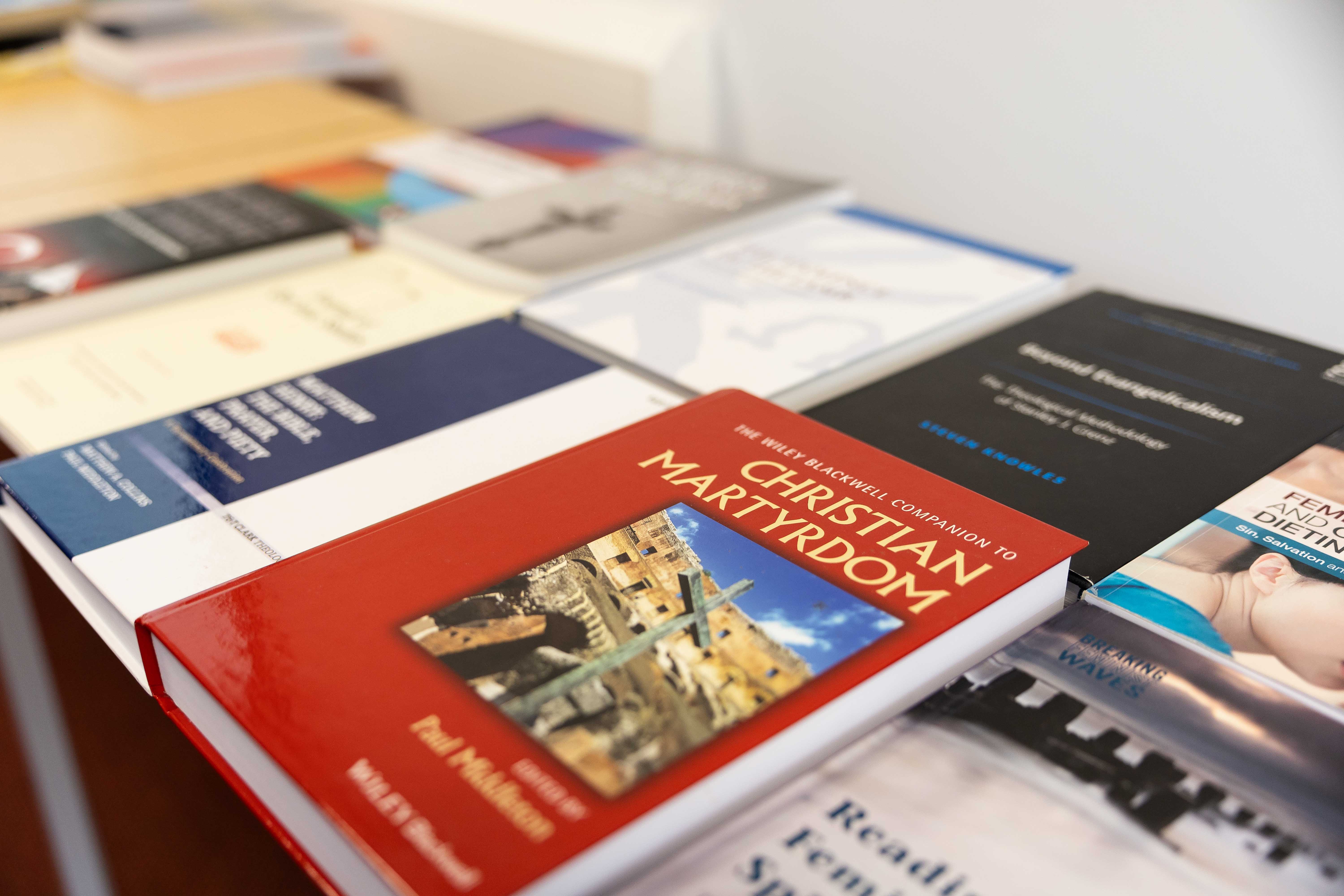




Theological books on a table

Are you looking for a flexible, research-driven MA which invites you to critically engage with key debates, texts, and traditions in the study of theology, philosophy, and religion? Do you want to be part of a vibrant and inclusive scholarly community, led by leading academics with internationally recognised research expertise? Our Master's in Theology and Religious Studies course allows you to explore your own areas of interest.

Our strong research culture drives our teaching and ensures that you work directly with experts at the forefront of their fields. With the opportunity to undertake taught study in optional topics such as God and Philosophy in the 20th Century, The Book of Revelation, or Qumran and the Dead Sea Scrolls, you can tailor your studies to match your academic and professional interests.

Alongside these taught options, you can choose to undertake independent study under specialist supervision, drawing on the areas within Theology and Religious Studies that most interests you. Examples of possible areas of study (indicative rather than exhaustive) include the following: religion and existentialism; queer theologies; Christology; the Hebrew Bible and the Dead Sea Scrolls; religious ethics and asceticism; political theologies; violence in early Christianity; religion, feminism, and gender.

The dissertation module gives you the opportunity to develop your own research interests further and will equip you with the necessary skills to do so. Examples of recent, successfully completed projects include: 'A Textual and Hermeneutical Analysis of the Biblical Exodus Narrative'; 'A Fieldwork-driven Exploration of Prayer in Jehovah's Witness Communities'; and 'A Study of Contemporary Catholic Social Teachings on Gender'. You will first discuss and develop your initial ideas with the course leader, before starting work with a specialist academic who will guide your research and writing on the dissertation from start to end.

Whether you are looking to advance your career, enrich your ministerial development, or simply explore the fascinating complexities of religion in today's world and in history, this MA equips you with valuable critical skills and specialist subject knowledge to do so.

Theology & Religious Studies Postgraduate ‘Find Out More’ events

Meet both staff and students to explore our Master's and Doctoral courses, discuss our PhD options, and learn about the unique nature of postgraduate studies with us. On 1st Jul 2026. Book now


Why You'll Love It

Theology and Religious Studies MA at the University of Chester

Theology and Religious Studies MA

What You'll Study

You'll study a two-part core module and will undertake a research dissertation on a topic of your choice. You will also choose four optional topics:

Core Modules

This module equips students with the academic study skills required for study in Theology and Religious Studies at Level 7, as well as providing an introduction to biblical studies and the study of theology from subject experts. By running in parallel with the Theology and Religious Studies research seminar series, you will also begin to engage with academic research culture.

This module continues from Studying Theology and Religion (Part I) in equipping students with the academic study skills required for study in Theology and Religious Studies at Level 7. In Part II, the focus is on preparation to be an active contributor to academic research culture, engaging with current and advanced research. The module equips you to engage with current scholarship critically and constructively and develop your own critical perspective, your ability to articulate cogent arguments and your own scholarly voice in respectful, responsible dialogue with others.

This module offers flexible ways to study issues and themes in Theology and Religious Studies to an advanced level, building on your learning in 'Studying Theology and Religion'. You may study advanced issues and themes on the subject of God and Philosophy in the 20th Century by self-directed learning supplemented with hybrid online seminars (international students studying in the UK attend these seminars in person); or by supervised, independent study in Theology and Religious Studies; or by attending and critically reflecting on an academic conference in your choice of sub-field in TRS.  

You will choose the focus of your research in conversation with the Course Leader: something that you are passionately interested about, personally and/or professionally, within the broad fields in Theology and Religious Studies in which we specialise. The dissertation is based upon guided, but largely independent, research. Research methodology forms part of supervision and of the submitted dissertation.

This module offers flexible ways to develop your learning further by exploring topics and problems in Theology and Religious Studies to an advanced level, building on your learning in 'Studying Theology and Religion'. You may study advanced issues and themes by attending hybrid online seminars on the Book of Revelation (international students studying in the UK attend these seminars in person); or by supervised, independent study in Theology and Religious Studies; or by attending and critically reflecting on an academic conference in your choice of sub-field in TRS.

This module offers flexible ways to study questions and subjects in Theology and Religious Studies to an advanced level, building on your learning in previous modules. You may study advanced issues and themes by taking part in a hybrid taught residential focusing on Contemporary Islam (international students studying in the UK attend this residential in person); or by supervised, independent study in Theology and Religious Studies; or by attending and critically reflecting on an academic conference in your choice of sub-field in TRS.  

In this module, you will explore an aspect of advanced study in Theology and Religious Studies, through one of the alternative paths through the module: you may study advanced issues and themes by self-directed learning about Qumran and the Dead Sea Scrolls (this pathway is not available to international students studying in the UK); or undertake supervised, independent study in Theology and Religious Studies; or attend and critically reflect on an academic conference in your choice of sub-field in TRS.  

The information listed in this section is an overview of the academic content of the course that will take the form of either core or option modules and should be used as a guide. We review the content of our courses regularly, making changes where necessary to improve your experience and graduate prospects. If during a review process, course content is significantly changed, we will contact you to notify you of these changes if you receive an offer from us.

How You'll Learn

An aerial photograph of Exton Park with the text 'How we teach at the University of Chester'

How we teach at the University of Chester

You can choose how you learn, opting for in-person teaching, remote online learning, or any combination of the two that suits you best.

Our state-of-the-art facilities for hybrid learning mean you will be part of a lively postgraduate community spanning the UK, and you will learn alongside peers from diverse backgrounds.

Our course is designed to accommodate students with external work commitments, and all our hybrid seminars take place between 17:00 and 19:00.

Your Future Career

Job Prospects

This course develops skills in empathy, cultural sensitivity, and religious literacy valued by employers. Students may go on to work in a number of professions, including teaching, banking and financial business, marketing and advertising, publishing, civil service, health and social care, counselling, and customer service. 

Careers Service

The University has an award-winning Careers and Employability service which provides a variety of employability-enhancing experiences; through the curriculum, through employer contact, tailored group sessions, individual information, advice and guidance.

Careers and Employability aims to deliver a service which is inclusive, impartial, welcoming, informed and tailored to your personal goals and aspirations, to enable you to develop as an individual and contribute to the business and community in which you will live and work.

We are here to help you plan your future, make the most of your time at University and to enhance your employability. We provide access to part-time jobs, extracurricular employability-enhancing workshops and offer practical one-to-one help with career planning, including help with CVs, applications and mock interviews. We also deliver group sessions on career planning within each course and we have a wide range of extensive information covering graduate jobs.

Entry Requirements

Honours Degree

Normally a 2:2 honours degree in a Humanities subject is required. Applicants with a degree in another discipline should contact us for advice. Those with appropriate relevant experience but who do not have a degree will also receive consideration.

Other Admission Requirements

As part of the selection process, applicants may be required to submit a piece of academic work and/or attend an interview.

Students from outside the UK are expected to hold qualifications broadly equivalent to UK standards - a Bachelor's degree (or equivalent) for postgraduate study.

To help you interpret these equivalents, please select your country/region of residence. This will provide details on equivalent entry requirements, as well as information about local representatives, events, and key contacts.

We accept a wide range of qualifications and assess all applications on an individual basis. Relevant work experience may also be taken into consideration where appropriate.

For more information on English entry requirements, including accepted qualifications, please visit International Entry Requirements.

Honours Degree

Normally a 2:2 honours degree in a Humanities subject is required. Applicants with a degree in another discipline should contact us for advice. Those with appropriate relevant experience but who do not have a degree will also receive consideration.

Other Admission Requirements

As part of the selection process, applicants may be required to submit a piece of academic work and/or attend an interview.

Fees and Funding

£9,090 for a full-time course (2026/27)

The tuition fees for home students studying courses in 2026/27 are £9,090 per year.

Guides to the fees for students who wish to commence postgraduate courses are available to view on our Postgraduate Fees page. Here you will also find information about part-time fees and project/placement year fees.

£15,500 (2026/27)

The tuition fees for international students studying courses in 2026/27 are £15,500 per year.

Irish Nationals living in the UK or ROI are treated as Home students for Tuition Fee Purposes.

For more information about International fees for Postgraduate study, go to our International Fees, Scholarship and Finance section.

Who You'll Learn From

Enquire about a course